

Blog
Why Do Pakistani Brides Wear Multiple Outfits at Their Wedding?
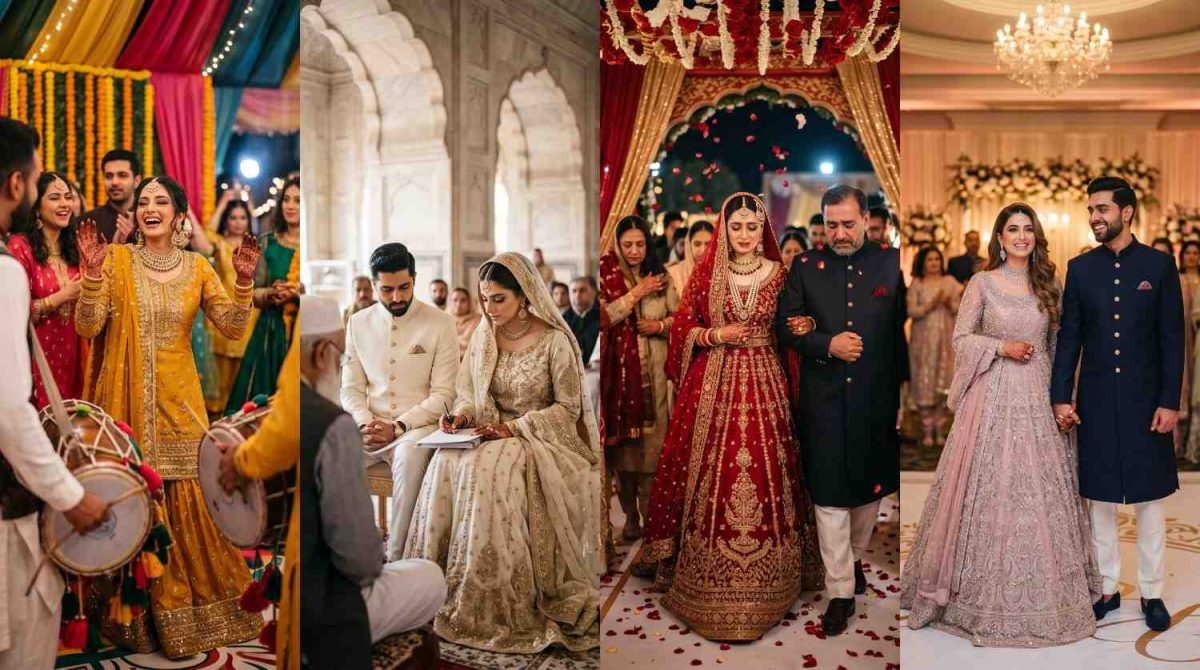
Pakistani brides wear multiple outfits because a Pakistani wedding is not one event it is a sequence of distinct ceremonies, each marking a different stage of the bride’s transition: from daughter, to wife, to daughter-in-law. Each ceremony carries its own religious weight, emotional register, and centuries-old color symbolism. The outfit changes are not a fashion statement. They are a language and every color, silhouette, and level of embellishment communicates exactly where in that transition the bride currently stands.
A Pakistani bride typically wears three to five outfits across her wedding. At UK boutique prices, this wardrobe is often the single largest expense in the wedding budget after the venue.
What Are the Different Pakistani Wedding Events and Why Does Each Require a Different Look?
Understanding the outfit changes starts with understanding why the events themselves are distinct. A Pakistani shaadi is not one celebration stretched across multiple days. Each event has a different host, a different guest list, a different emotional tone, and for the bride a different role to perform.
The Mehndi is hosted informally, typically by the bride’s family, and centers on henna, music, and dancing. The Nikkah is the Islamic marriage contract intimate, spiritual, and legally binding. The Barat is the formal wedding day, hosted by the bride’s family, where the groom arrives with his procession and takes the bride away at Rukhsati. The Walima is the reception hosted by the groom’s family, the official welcome of the bride into her new home.
Each of these events demands a different version of the bride, because each one is a different version of her story.
What Does Each Wedding Outfit Represent and Why Are the Colors Different?
Why Does the Mehndi Bride Wear Yellow or Green?
Yellow is the traditional Mehndi color because it represents fertility, joy, and new beginnings, the same associations carried by turmeric, the plant-based paste applied to the bride’s skin in the Mayun ceremony days earlier. Green carries connotations of prosperity and life.
The Mehndi dress is deliberately lighter and less embellished than the Barat lehenga because it is made for dancing. Heavy zardozi and kora embroidery restrict movement. Gota-patti trim, mirror work, and resham thread work are preferred; they catch the light as the bride moves. The mood is joyful and informal; the dress matches it.
For British-Pakistani brides, the Mehndi palette has evolved. Mustard, burnt orange, and terracotta are increasingly popular alongside traditional yellow, particularly for brides who feel pure yellow is unflattering under UK indoor event lighting. The spirit of the palette brightness, festivity, and life is preserved even when the exact shade shifts.
Why Does the Nikkah Dress Change to White, Ivory, or Pastel?
The Nikkah is the moment at which the bride becomes legally and spiritually a wife under Islamic law. The nikahnama is signed. Qubool hai “I accept” is said three times. Two witnesses confirm consent from each side.
The Nikkah outfit reflects this solemnity. Whites, ivories, and soft pastels convey purity and the gravity of a spiritual commitment. Embellishments are typically delicate pearl work, fine threadwork, subtle zari rather than the showpiece embroidery of a Barat lehenga. The dress signals that this moment is about the sacred, not the spectacular.
In the UK, many families combine the Nikkah and Barat on the same day Nikkah at the mosque in the morning, Barat at the venue in the evening. This means the bride needs a Nikkah-specific outfit that is mosque-appropriate: modest, covered, and elegant without requiring a full glam team to change into.
Why Is Red the Non-Negotiable Color for Barat?
The Barat is the central wedding day. The groom arrives with his procession, friends, family, dhol and the evening ends with Rukhsati: the bride’s farewell from her family home. It is the most emotionally charged event of the entire shaadi.
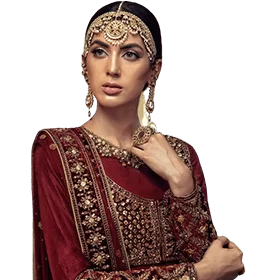
Red is the Barat color because it carries centuries of symbolic weight: love, passion, the courage required to leave everything familiar, and blessings for the couple’s shared life. The Barat lehenga is the most heavily embellished outfit the bride wears across all events zardozi, dabka, kora, stone work, and gota-patti borders are all standard. This is the dress that defines how the bride is remembered and photographed.
In the UK, deep maroon, magenta, and gold are increasingly common alongside traditional red. Many British-Pakistani brides find that pure red reads differently under British indoor event lighting and warmer tones photograph better. The weight and grandeur of the Barat dress, however, never changes.
Why Is the Walima Dress Always Lighter and Softer?
The Walima is hosted by the groom’s family, not the bride’s. Its Islamic basis is as a Sunnah obligation: the groom publicly announces and celebrates his marriage to the community. The bride, for the first time, is a guest in the space she is entering as a member.
The Walima outfit is lighter because the bride’s role has changed. Pastels, soft blues, silver, and mint green are traditional Walima colors; they signal arrival and new beginning rather than the departure drama of Rukhsati. Lighter fabrics like chiffon and organza replace the raw silk and heavy net of the Barat dress. The embellishment level drops deliberately, both symbolically and practically, as the couple moves from spectacle to everyday life.
Is the Multiple-Outfit Tradition Religious or Cultural?
This is one of the most misunderstood aspects of Pakistani weddings and the distinction matters. Islamically, only two events are required: the Nikkah (the marriage contract) and the Walima (the public reception). Mehndi, Barat, Dholki, Mayun is a cultural tradition rooted in Mughal-era South Asian celebration custom, not Islamic obligation.
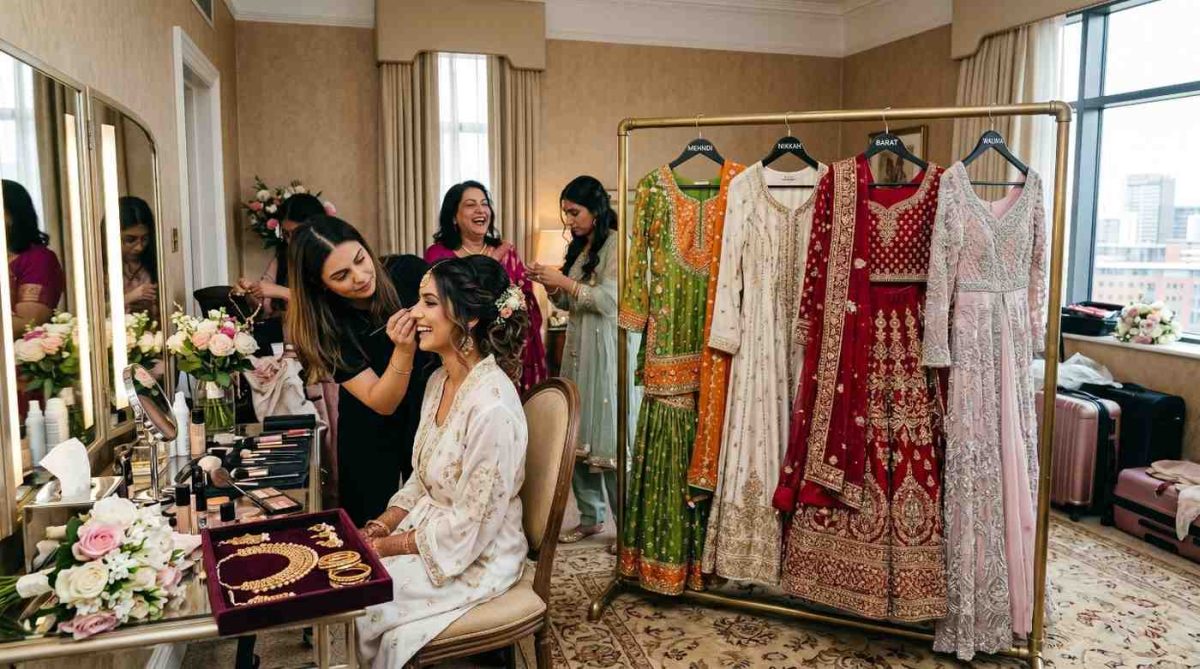
Mughal court culture codified the extended multi-day wedding across the subcontinent. Brides were presented differently at each stage as a reflection of family status and the gravity of the occasion. That expectation has passed through generations and persists today now expressed through boutique embroidery and designer labels rather than royal court ateliers.
This distinction matters practically for British-Pakistani brides navigating family expectations. Fewer events and fewer outfit changes are religiously permissible. What they represent is a departure from inherited cultural custom and that carries its own social weight within the community, regardless of religious position.
Do British-Pakistani Brides Follow the Same Outfit Rules as Brides in Pakistan?
Broadly yes but with significant practical adaptations.
In Pakistan, wedding events typically span three to seven days across separate venues. In the UK, the same traditions compress into a two-to-three day weekend. Guests cannot take a working week off, and UK venues cost far more per day than their Pakistan equivalents.
This compression does not reduce the outfit count, it intensifies the pace. A British-Pakistani bride in Birmingham or Bradford may have her Mehndi on Friday evening, Nikkah Saturday morning, Barat Saturday evening, and Walima Sunday afternoon. Each requires a distinct dress, makeup look, and jewelry set, all within 72 hours.
There is also a visible generational divide in how rigidly outfit codes are followed in the UK. Older families particularly those with roots in Punjabi or Azad Kashmiri tradition tend to enforce traditional color conventions strictly, especially Barat red and Mehndi yellow. Younger British-Pakistani brides, particularly Gen Z, are more likely to reinterpret the palette while keeping the structure of distinct outfits per event.
Can a Pakistani Bride Wear Fewer Outfits Without Breaking Tradition?
Yes and many do. The absolute minimum is one outfit for Nikkah and one for Walima. The events between are cultural expectations, not religious mandates.
| Format | Outfit Count | What’s Combined |
| Full traditional | 5–6 | Dholki, Mayun, Mehndi, Nikkah, Barat, Walima |
| Standard UK Pakistani wedding | 3–4 | Mehndi, Barat, Walima (+ optional separate Nikkah) |
| Condensed UK format | 2–3 | Nikkah/Barat same day, Walima separate |
| Islamic minimum | 2 | Nikkah + Walima only |
The Barat and Walima outfits are almost never combined or eliminated. Both families host one event each, and both remain the cultural anchor of the entire shaadi. The Mehndi outfit, by contrast, is the most flexible; it is increasingly rented rather than purchased in the UK, and its color conventions are the most open to modern interpretation.
Frequently Asked Question
Why do Pakistani brides change outfits multiple times in one day?
In the UK, Pakistani wedding events are often compressed into a single weekend. Brides may wear a Nikkah dress in the morning at the mosque and change into their Barat lehenga for the evening event at the venue. A second outfit change mid-event into a lighter reception look is increasingly common at Barat celebrations where the bride starts the evening in full embellished lehenga and changes later when dancing begins. Each change reflects a different moment in the day: the spiritual ceremony, the formal reception, and the celebration.
Is it necessary for a Pakistani bride to wear red at her Barat?
Red is the strongest cultural convention for a Barat dress, but it is not a religious requirement. In Pakistan and across the UK diaspora, deep maroon, magenta, burgundy, and gold are widely accepted alternatives particularly for brides who find that cool-toned reds photograph poorly under UK indoor venue lighting. What matters more than the exact shade is that the Barat dress is the most heavily embellished outfit in the bridal wardrobe. The weight and grandeur of the outfit is the real convention; the precise color is increasingly a personal choice within a warm-toned spectrum.
What is the difference between the Nikkah and the Barat in a Pakistani wedding?
The Nikkah is the Islamic marriage contract, the legally and spiritually binding ceremony where the bride and groom both consent, witnesses confirm, and the nikahnama is signed. It can be a small, intimate gathering at a mosque or family home. The Barat is the cultural wedding celebration that often follows the Nikkah. The groom arrives with his family and friends, there is a formal reception, and the evening ends with Rukhsati, the bride’s farewell from her family. Many UK families hold both on the same day, with Nikkah in the morning and Barat in the evening.
Why does the Walima outfit look so different from the Barat dress?
Because the bride’s role and emotional position have completely changed. At Barat, she is leaving and her dress reflects departure, drama, and the weight of that transition. At Walima, she arrived hosted by the groom’s family, welcomed into her new community. Lighter fabrics, softer colors, and less embellishment are traditional for Walima because they convey a beginning rather than an ending. The visual contrast between the two outfits is culturally intentional, not a random aesthetic choice.
Do Pakistani brides in the UK rent or buy their wedding outfits?
It depends on the event. The Barat dress, the central wedding day outfit, is almost always purchased, given its symbolic importance and the expectation that it will be preserved. Mehndi and Walima outfits are increasingly rented by British-Pakistani brides in the UK, particularly as rental boutiques expand their Pakistani designer collections in cities like Birmingham and Manchester. Renting a Mehndi outfit can cost £150–£350 versus £600–£1,500 to purchase a significant saving for a dress worn for one evening of dancing.


 New Arrivals
 Ready To Wear
 Kid’s Clothing
 Wedding Wear
 Men’s Wear
 Jewellery
 Designers
 Sale
Sale